Can a Family Reunion Shirt Go on Your Ancestor Altar?


No, baby. Even if that shirt lists only relatives who've passed, the family surname represents everybody carrying it, including those still living. In my practice, leaving something like that on an active ancestor altar is taboo. You're bringing the whole family into a working space without giving those living relatives an assignment.
Now, don't confuse that with doing work for your family. I absolutely use my altar for family workings, and I use it for enemy work too. The difference is purpose. When I'm working, I know exactly who I'm addressing, what condition I'm dealing with, and why that person's name is there.
A reunion shirt isn't a working. It's a family keepsake. Put it on a separate family shrine where it can stay and honor the lineage.
Keep your shrine for remembrance and your ancestor altar for active work.
1. The Separation of the Living and the Dead in Hoodoo
Now, listen, because this is one of those spiritual boundaries I don't play with. In Hoodoo, keeping the living separate from the dead on an ancestor altar is a serious matter. And yes, that includes something as ordinary as a family reunion shirt.
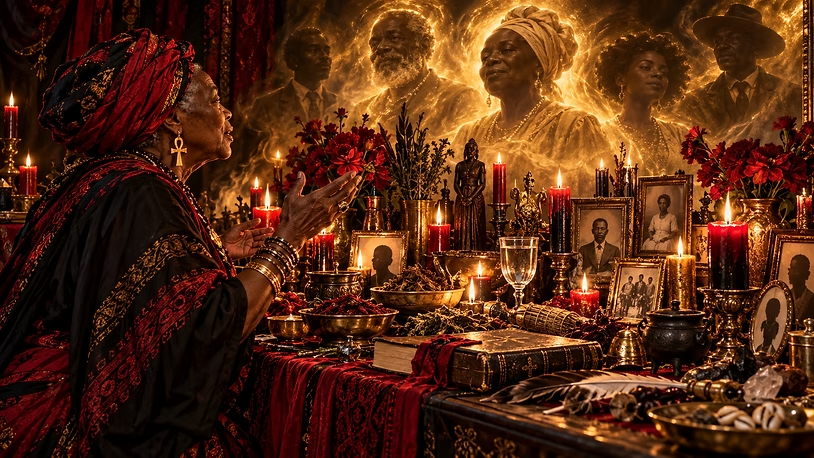
The Cold Line: Your ancestor altar is where you tend your relationship with the deceased through water, prayer, light, and offerings. You're maintaining a space where the dead are welcomed and cared for. In my teaching, bringing living people into that spiritual condition without a specific purpose exposes them to the influence of the dead (of course all of your dead should not be on your altar). We don't want the vitality of somebody still walking this earth being drawn into a space maintained for those who've crossed over.
The Family Name: Now, here's what people overlook. Even if that reunion shirt only lists deceased relatives, the surname represents everybody carrying it, including those still breathing. When I'm doing work for a living family member, that's different. I use their specific name and date of birth, a petition, and a clearly defined assignment. There's a purpose behind their presence in that working. But leaving a reunion shirt sitting there indefinitely? You're bringing the entire family line into an active working space without distinguishing who's living and who's dead.
2. The Working Altar Versus the Family Shrine
Here's where you need to understand the difference.
The Altar Is for Active Work: My working altar is where I handle spiritual business. I pray, petition, call on my spiritual court, and carry out assignments. That includes protection and healing work for family members, along with enemy work when the situation calls for it. Everything brought into that space needs a reason for being there.
The Shrine Is for Remembrance: A family shrine serves a different purpose. That's where you honor your family history, preserve keepsakes, and remember the people who came before you. Family Bibles, reunion shirts, and treasured photographs belong in that kind of space.
Now, don't confuse the two. An active altar and a remembrance shrine don't carry the same assignment in my practice. One is maintained for working, while the other preserves the family's memory.
3. Keeping the Living Out of Ancestral Representations
Here's another precaution I teach. Suppose the only photograph you have of your deceased grandmother includes your living aunt. Don't put that entire photograph on the ancestor altar. Use a separate copy and crop it so Grandma appears alone.
The same principle applies to that reunion shirt. You can't separate living relatives from a shared surname printed across the fabric. That name represents the family as a whole.
So, baby, keep the shirt on your family remembrance shrine. When you're doing a specific working for somebody living, bring their name to the altar for that assignment and handle it accordingly.
Your family shrine preserves the family. Your working altar handles spiritual business. Know the difference, and respect that boundary.


Comments