How to Deal with Unknown Ancestors in Hoodoo: Who Are You Calling?

Learn how to approach unnamed family dead, respect spiritual boundaries, and seek ancestral guidance responsibly.
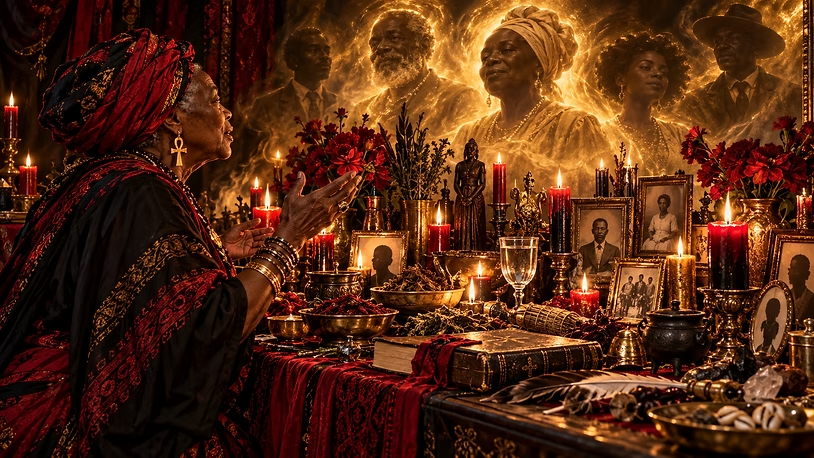
You know how a family can tell you every detail about Sunday dinner but get quiet when you ask about Grandma’s people? Baby, I know that silence. My family didn't sit around passing down the names and stories I needed. I took a DNA test and started researching my people because I wanted actual answers about my bloodline. I needed a starting point I trusted.
That's why I understand the question about working with unknown ancestors in Hoodoo. You're looking for your family dead, but the names aren't there. So who do you call? And what do you do when those storytellers are gone?
Listen, your lineage didn't begin with the oldest person anybody remembers. Those generations existed whether somebody wrote their names down or not. But knowing you have ancestors and knowing which spirits belong in your spiritual court are two different matters.
You don't have to invent an identity to acknowledge your family. You do need to understand whom you're inviting into a relationship. You can ask unknown ancestors to reveal themselves without opening your door to everybody.
Your Family Tree Has Roots Nobody Remembered
An ancestor is somebody deceased from your family line. Your great-grandmother counts whether you have her photograph or not. So does the woman who raised her. A missing name describes a gap in what you know; it doesn't take that person out of your bloodline.
And our family histories carry some hard gaps. Enslavement separated Black relatives and interrupted the passing down of family knowledge. Hurston discussed that disruption in her account of African American Conjure (Hurston, 1931). But don't assign the same explanation to every unanswered question in your family. Silence comes from other circumstances, too. Some relatives still refuse to talk about what happened.
Here's where I want you to pay attention. Finding relatives through DNA matches, public records, or a family Bible helps establish genealogy. It doesn't tell you which deceased person is standing beside you spiritually. Research identifies people; communication requires a different kind of examination. Keep those responsibilities in their proper places.
Now, the family dead aren't one big group with the same character or intentions. Everybody who dies doesn't become an ancestor you should consult for guidance. Some relatives treated people badly while living. Others are remembered for care, wisdom, and protection. You wouldn't trust every living relative to handle your personal business. Don't abandon that judgment just because somebody crossed over.
And don't confuse an unidentified deceased spirit with your unnamed family ancestors. One is a spirit whose relationship to you hasn't been established. The other refers to people connected to you through descent, even if their names remain unknown. That's why the words used when approaching them matter. They establish whom you're addressing without pretending you've identified everybody.
So the question isn't whether your dead exist without a photograph. The real question is precisely which members of that ancestral lineage you are prepared to acknowledge, and how you begin without promising them a position in your court before any discernment takes place.
Don't Open the Door Before You Know Who's Knocking
Here's where an ancestor roll comes in. It's a written acknowledgment of the deceased family members you're honoring. Put the names you know on it, and include your unnamed ancestors under a clear description. Address the healed, ascended, and benevolent ancestors of your bloodline. That wording matters. I'm acknowledging family dead who are suitable for a respectful relationship, not sending out an invitation to every wandering spirit.
You can speak to those unnamed ancestors and ask them to reveal themselves. Wanting to know who stands behind your family line is natural. Ask for identification in a way you can recognize and examine. That doesn't mean every dream or name that pops into your head becomes proof. Pay attention, then seek confirmation rather than announcing something the minute you feel it.
This is where divination with your spiritual court comes in. You're examining whether the relationship is appropriate, whether the presence belongs to your people, and what the court directs you to do next. If you haven't established a divination practice, learn from somebody competent before claiming an answer. Don't keep changing the question until the reading says what you wanted to hear. Keep a dated record of each consultation.
Your ancestor roll isn't a contract appointing every name to a spiritual office. Remembrance has one responsibility; active cooperation carries another. Some ancestors receive acknowledgment while others are approached for guidance after consultation. Permission belongs in that process. So does your willingness to accept a refusal.
People want to rush straight into offerings, fancy tables, and candle arrangements. Hold on. What relationship have you established, and what care is appropriate? A photograph or glass of water doesn't answer that question for you. The court's instruction matters more than somebody's pretty setup online.
You can begin with respect while still learning your people. Let the relationship develop with understanding instead of trying to force a visitor to prove themselves on your schedule.
She Has the Bloodline, but Where's the Name?
Nia knows her maternal grandmother, Evelyn, but the names on her father's side stop with one surname. Nobody in the family talks about his grandparents. Nia wants to honor that side without pretending she knows the people who came before him.
She starts an ancestor roll using the relatives she can identify. For the others, she writes, “The healed, ascended, and benevolent ancestors of my paternal bloodline whose names are unknown to me.” She acknowledges them respectfully and asks that those who are appropriate to approach reveal their identities through means she can examine.
Now Nia has a question for divination: Is it appropriate to develop this relationship, and what should she do next? She's still learning to read, so she consults an experienced practitioner rather than interpreting every dream as an ancestral message. The consultation directs her to continue family research and maintain simple remembrance, without demanding immediate proof that somebody hears her. There's no assignment to perform for anybody.
Nia calls an older relative who remembers a church near her grandfather's childhood home. The church records identify a woman's name connected to that household, along with her daughter's baptism. Nia checks the relationship before adding it to her family history. She doesn't claim a spirit physically placed the record in her hands.
Spiritually, she now has something worthwhile: a clearer direction for honoring her paternal dead, and a method for examining future communication. The unknown names on her roll aren't treated as strangers. Nor does one discovery give her permission to appoint the whole lineage to her court.
Your Ancestors Aren't a Spiritual Customer Service Desk
Baby, a relationship with the dead isn't a customer service number you dial when life gets rough. Once you establish regular contact, understand what you've agreed to maintain and what stays outside that relationship. Respect includes knowing when to stop.
And here's the question that matters next: when an unnamed ancestor begins revealing their identity, how do you determine whether that person has a place in your spiritual court? A name alone doesn't answer it. That's where divination, permission, and spiritual responsibility meet.
Over at Southern Fire Syndicate on Substack, I go further into the ancestor roll, asking for revelation, examining responses, establishing offerings, and learning when ancestors receive assignments. You deserve instruction that respects your people and your judgment.
Next: What Really Belongs on Your Hoodoo Ancestor Altar?
Until your next working, walk with structure, rest with discipline, and remember: your altar rises when you do.

Comments