Hoodoo Ancestor Altar: Can You Practice Hoodoo Without a Permanent Altar?

Your family's dead remain your people; divination clarifies when a dedicated altar becomes spiritually necessary.

Hoodoo Ancestor Altar: Your Ancestors Didn't Sign That Lease
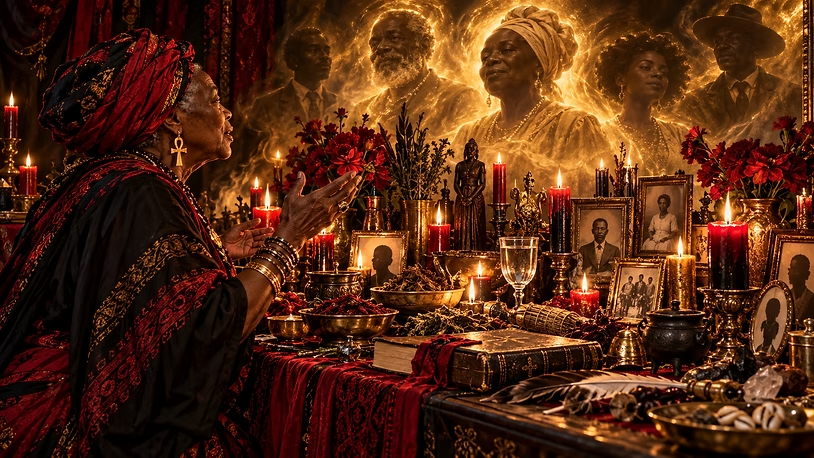
Somebody told you that practicing Hoodoo requires a permanent ancestor altar, and now you're questioning whether you belong without one. Let me ask you something: since when did a piece of furniture determine your relationship with your family dead? That's a serious claim, and we need to examine it. Listen, your ancestors knew what it meant to make do with the room life gave them. Don't mistake an internet instruction for the voice of your spiritual court.
The question isn't whether you've got a corner to decorate. It's whether your present ancestral responsibilities actually require a dedicated physical space. Some relationships involve remembrance; other responsibilities arise through established consultation. Knowing which one you're dealing with changes your next move entirely.
Some people live in dorms. Others share homes with relatives who don't understand Hoodoo, or worse, condemn it as something evil. And some simply don't have room for a permanent ancestor altar. Since when did your living situation determine whether you can honor your own family dead with respect?
No Table Doesn't Mean No Family Dead
An ancestral relationship doesn't begin with furniture. Your dead remain family whether you're renting, studying away, or staying on somebody's couch. The dedicated altar is a place assigned to spiritual care. Its absence doesn't erase your lineage or settle what your ancestors expect from you.
African American Hoodoo wasn't practiced the same in every household. Families maintained their own ways of honoring the dead, and those customs varied across communities. A permanent ancestor altar wasn't a universal requirement for everyone who practiced Hoodoo. Don't let somebody else's family instructions become a commandment over your own spiritual relationship.
In my practice, God holds the highest authority. Ancestors have their own relationships and responsibilities within the spiritual court, and those responsibilities aren't issued by a piece of furniture. You can remember your family that has passed on, speak their names, and give thanks for their lives without promising a permanent installation.
But don't swing to the opposite extreme and insist physical spaces never matter. A court-directed undertaking has its own requirements. That's different from taking a quiet moment to acknowledge your honored dead. Now the real question becomes: Is there a specific responsibility you've accepted that needs a space, or are you carrying guilt somebody else handed you?
Ask Your Court Before You Rearrange Your Life
Now, if you're living under somebody else's roof, respect that. They pay bills there too, and everybody isn't comfortable with Hoodoo. You don't owe an explanation to somebody determined to call your ancestors evil. Don't turn your altar into a household battle. That doesn't serve your people.
Be clear about what you're doing. Speaking your daddy's name in remembrance isn't the same as carrying out spiritual work that needs a dedicated place. When your court assigns work, know what it requires. Don't assume everything has to happen in your bedroom.
That's when divination comes in. Ask your court whether the work needs a physical location, whether a temporary arrangement is acceptable, or whether it should wait. Don't keep changing the question until you get permission that wasn't given. If the reading isn't clear, leave it there instead of putting words in your people's mouths.
You've got options. Perhaps this isn't the time to set anything up. A temporary space might serve a particular assignment. Or the work waits until your living situation changes. That's not neglecting your ancestors. You honor your spiritual responsibilities by knowing what you have agreed to and whether you have the means to carry them out.
Grandma Ain't Moving Into Your Sister's House
Consider Alicia, who's staying with her sister while saving for an apartment. Her sister doesn't want a permanent altar. Alicia feels torn. She respects the rules but fears Grandma will think she's turning away.
Her actual concern isn't finding a hidden shelf. She wants to maintain her ancestral responsibilities without imposing them on her sister.
In this example, Alicia consults her spiritual court through the divination method she knows. The reading doesn't assign a permanent altar for her current responsibilities. She continues her appropriate ancestral acknowledgment privately and leaves her sister's home undisturbed. She doesn't announce that every ancestor accepts the same arrangement; she's following the direction relevant to her own relationship.
Later, Alicia considers a working that needs a dedicated place for tending. Instead of squeezing it behind her clothes, she examines whether the assignment allows another location or should wait. The practical result is clear: her family boundaries remain respected, and she hasn't made promises she cannot keep. The bedroom stays usable for everyday living.
The deeper spiritual question is what to do when a court confirms an assignment but your present living conditions won't allow it.
Sometimes Waiting Is the Work
Even when your court gives a clear assignment, that doesn't erase responsibility for its conditions. Tell your people honestly what you can and cannot maintain. Spiritual obedience isn't about moving in secret and hoping things work out. If the assignment needs dedicated space, consult your court about the timing. Until that's settled, let the work rest. Don't borrow trouble to prove devotion.
At Southern Fire Syndicate on Substack, I examine court-directed requirements, temporary arrangements, and when postponing a working is the responsible decision. Your relationship deserves discernment, not borrowed rules. Read the ancestor series.
Want to understand more about ancestral relationships and the reasoning behind Hoodoo? Explore related articles at her or when you're ready to go deeper, join Southern Fire Syndicate on Substack for teachings that take you from foundational African American Hoodoo through advanced Conjure practice, including historical study, ancestral relationships, divination, spiritual authority, and rootwork.
Read Next: When Does Ancestor Work Require a Dedicated Altar?
Until your next working, walk with structure, rest with discipline, and remember: your altar rises when you do.

Comments